
Last updated October 17, 2026
 Metal roofing
 Tile roofing
 GAF
GAF Owens Corning
 Flat & low-slope
Free roof inspection with deck photos before we talk money - GAF and Owens Corning certified installation
DIY vs Professional Roofing: The San Francisco Homeowner’s Decision Guide
Here’s a number most San Francisco homeowners never see coming: the owner-builder roofing permit you’re legally entitled to pull as a California resident comes with an in-person inspection requirement from the Department of Building Inspection that happens during the job, not after. That means if you re-cover your deck before the inspector arrives, you’re tearing it back off. Most DIYers discover this rule about three days too late. This guide walks through the real calculus of doing your own roof work in San Francisco: what the DBI actually requires, which tasks are genuinely safe for a weekend, where the cost math breaks down, and the specific scenarios where hiring a licensed roofer isn’t just easier, it’s the only legally sound option.
Styles & brands we work with
Quick Answer
For minor, no-permit tasks like gutter clearing, sealant touch-ups, and single shingle replacement, a capable San Francisco homeowner can DIY safely and legally. For anything involving structural deck repair, full re-roofing, parapet walls, or rooftop deck waterproofing, the city’s permitting rules, owner-builder disclosure requirements, and steep-slope safety risks make professional roofing the only sensible choice. When you do hire, get a written price before work starts.
Table of Contents
- What You Can Legally DIY on a San Francisco Roof
- The Owner-Builder Permit Process in San Francisco: Real Steps, Real Costs
- Why San Francisco’s Steep Slopes and Hillsides Change the Safety Calculus
- The True Cost Comparison: DIY vs Written Professional Quote
- The One Scenario Where DIY Always Loses: Parapet Walls and Rooftop Decks
- Hidden Liability: What Unpermitted Roof Work Means When You Sell
- What a Professional Roofing Crew Actually Does Differently
- Common Mistakes to Avoid
- When to Call a Professional
- Frequently Asked Questions
- The Bottom Line
What You Can Legally DIY on a San Francisco Roof
The San Francisco Department of Building Inspection draws a bright line between maintenance and construction. Maintenance doesn’t require a permit. Construction does. Here’s where that line sits in practice.
These tasks are legal DIY territory for a San Francisco homeowner:
- Gutter clearing and downspout flushing. No permit, no license, no inspection. Just don’t lean a ladder against a rotted fascia board.
- Sealant touch-ups around vents, pipes, and skylights. If the flashing is intact and you’re refreshing caulk or sealant, you’re maintaining, not constructing. Use a product rated for San Francisco’s salt air if you’re west of Twin Peaks.
- Single shingle or tile replacement. Replacing one or two damaged shingles where the underlying deck and underlayment are sound falls under repair, not re-roofing. The DBI doesn’t require a permit for isolated shingle replacement.
- Debris and moss removal. San Francisco’s fog belt neighborhoods, the Sunset, the Richmond, West Portal, grow moss faster than most of the city. Brushing it off beats letting it hold moisture against the roof surface.
- Visual inspection. Binoculars from the sidewalk, a careful look from an upstairs window. Knowing what’s happening up there before it becomes a ceiling stain is homework any homeowner can do.
What changes the classification is scope. The moment you’re lifting more than a few shingles, exposing decking, replacing flashing at a wall intersection, or touching anything structural, you’ve crossed into permit territory. The DBI treats roof covering replacement of more than 25% of the roof area as a re-roof, and re-roofs require a permit. No gray area.
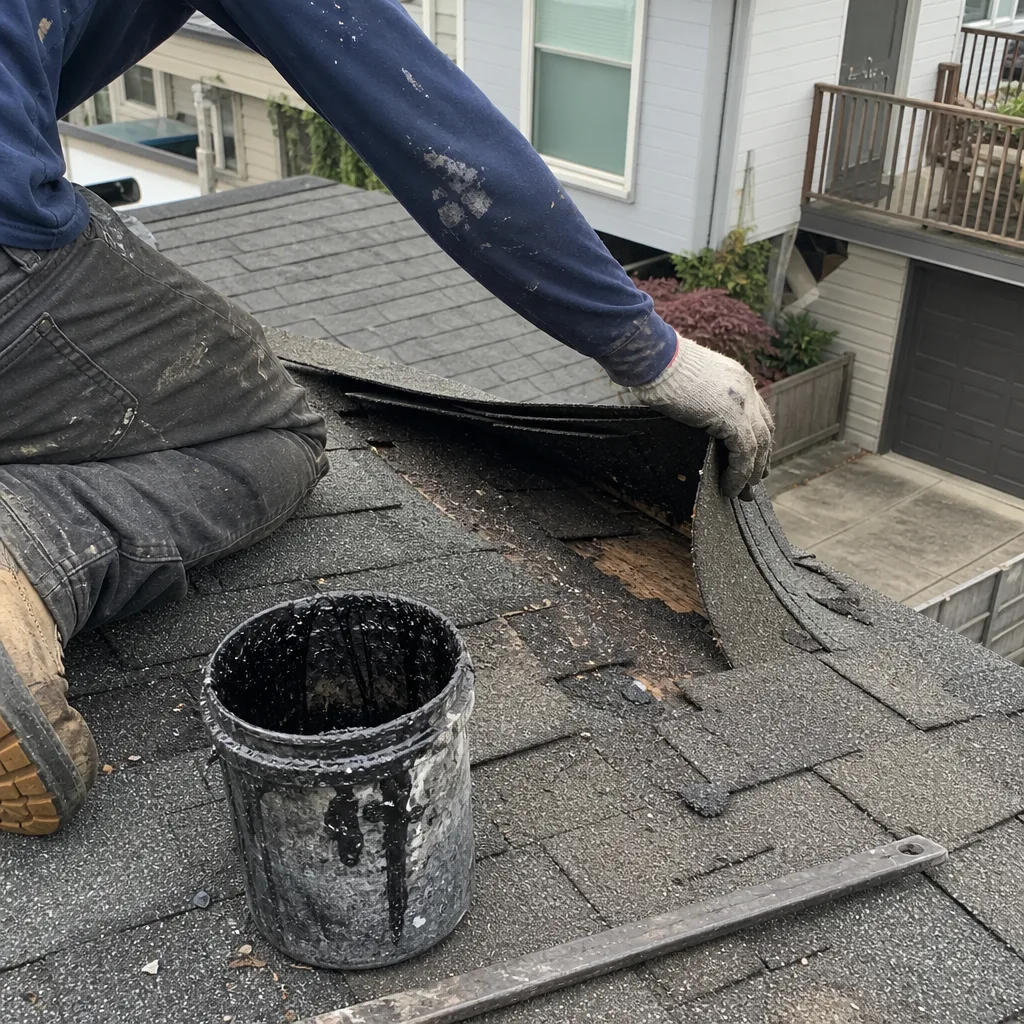
In our experience across San Francisco, the most common DIY-overreach scenario goes like this: a homeowner in Noe Valley pulls up three shingles to fix a leak, finds rotted decking underneath, and keeps going. By the time they’re done, they’ve effectively re-roofed a section of their home without an inspection. That’s a problem for insurance, for resale, and potentially for their neighbor’s ceiling.
The Owner-Builder Permit Process in San Francisco: Real Steps, Real Costs
California’s owner-builder law lets a homeowner act as their own general contractor on their own residence. That includes pulling a roofing permit. But San Francisco’s DBI process is deliberately more hands-on than most counties, and the in-person inspection requirement catches people off guard.
Here are the steps, in order, for an owner-builder roofing permit in San Francisco:
- File an owner-builder declaration with the DBI. This form certifies that you own the property, you live there, and you understand that you’re legally responsible for the work and any future buyer disclosure.
- Pay the permit fee. For a typical single-family re-roof, San Francisco permit fees typically run between $400 and $900 depending on roof area and valuation. You’ll also pay a records retention fee and sometimes a surcharge for the DBI’s inspection program.
- Schedule the in-progress inspection. This is the step that surprises people. The DBI requires an inspection after the old roofing is torn off but before the new underlayment and roof covering go on. The inspector is looking at deck condition, fastening, and underlayment type. If you’ve already covered the deck, you’ll be told to remove the roofing in a representative area so the inspector can see the deck. This rework is on your dime and your time.
- Complete the work and schedule final inspection. The final inspection verifies the roofing system meets San Francisco’s current building code, including the city’s specific wind-uplift requirements for roofs in exposed areas like the Presidio, the Outer Sunset, and Twin Peaks.
- Retain the permit records. When you eventually sell, California law requires you to disclose that you performed the work as an owner-builder. Title companies and buyers will ask. Having clean permit records and inspection sign-offs makes the disclosure a footnote instead of a negotiation problem.
The time cost is real. The DBI schedules inspections on its own calendar. A professional roofing company, by comparison, pulls the permit, coordinates the inspection, and has the work scheduled around the inspector’s availability as a matter of course. You’re not saving time by DIYing the permit process; you’re spending it.
More important: when a Roofing Company in San Francisco pulls the permit, the contractor’s license number goes on the paperwork. That shifts long-term liability for the work to the contractor’s insurance and bond. When you pull an owner-builder permit, the liability for any defect, any future leak, any code issue is yours. Period. For a $25,000 re-roof, that’s a lot of personal exposure to save a $600 permit coordination fee.
Why San Francisco’s Steep Slopes and Hillsides Change the Safety Calculus
A YouTube tutorial filmed on a 4/12 ranch roof in Ohio doesn’t translate to a 10/12 Victorian in Eureka Valley. San Francisco’s housing stock tilts steeper, sits on hillsides, and packs homes closer together than almost any city in the country. That geometry changes the risk equation.
On a steep-slope roof, the fall distance isn’t the only hazard. It’s the run-out. A slip on a 10/12 pitch sends you over the eave, not into it. Professional crews use roofing brackets, toe boards, safety harnesses with roof anchors, and often a fall-restraint system rated for the pitch. The equipment alone for a proper safety setup on a steep San Francisco roof runs several hundred dollars in rental fees per week, assuming you know how to rig it correctly. Most DIYers don’t.
Hillside roofs add another layer. A home built into a hill in Glen Park or Diamond Heights might have a roof edge that’s effectively two or three stories above the downhill neighbor’s property. If you drop a bundle of shingles, a pry bar, or yourself, the liability isn’t just your injury. It’s damage to your neighbor’s deck, windows, car, or person. Your homeowner’s insurance may cover some of that, but only if you were doing the work legally and with reasonable safety precautions. Dropping a hammer off a roof because you weren’t tied off isn’t the kind of “reasonable” insurance adjusters reward.
San Francisco’s wind is the third factor. The same wind that makes the Outer Sunset a terrible place to spread loose tarps is the wind that catches a half-installed shingle bundle and sends it airborne. Professional crews stage materials in small quantities on steep roofs, and they know when to call a day for wind. A DIYer with a flat Midwestern frame of reference for “windy” is in for a surprise on an October afternoon in the Richmond District.
The safety caveat here isn’t abstract. Roof falls are among the leading causes of construction fatalities in the United States, and steep-slope residential roofs account for a disproportionate share. If you’re not trained in fall protection and you’re not physically comfortable on a pitched surface with proper tie-off, the honest answer is that you shouldn’t be up there. No money saved on labor is worth a fall from a second-story eave.
The True Cost Comparison: DIY vs Written Professional Quote
The DIY pitch is always the same: “Materials are $2,500, and the contractor quoted $9,000. I’ll save $6,500.” Here’s the honest math for a typical 1,500 to 2,000 square foot re-roof in San Francisco.
DIY costs, realistically:
- Materials: $2,800 to $4,500 for architectural shingles, underlayment, ridge caps, drip edge, and fasteners. That’s mid-grade material, not builder-grade, because you’re shopping at retail prices, not contractor wholesale.
- Permit fees: $400 to $900 as detailed above.
- Tool and equipment rental: $300 to $700 for a debris chute, roofing nailer, compressor, ladders, safety harness and anchors, and a dumpster or debris trailer if you’re not hauling to the transfer station yourself.
- Disposal fees: $400 to $800 for the old roofing. San Francisco’s Recology bulky item pickup doesn’t take construction debris; you’re hauling it or renting a bin.
- Your time: A two-person DIY re-roof takes four to seven weekends when neither person is a professional. At even $40 an hour of your time, eight days of work is over $2,500.
Realistic DIY total: roughly $6,400 to $9,400 plus four to seven weekends of your life, plus inspection rescheduling, plus the risk of rework if the inspector doesn’t like what they see.
A professional written quote in San Francisco for the same scope typically lands between $12,000 and $18,000 for architectural shingles, including tear-off, permit, inspections, disposal, materials, and labor. When we at Birchbark write a quote for a San Francisco homeowner, that number is in writing before any work starts. There’s no “we ran into unexpected rot” adjustment after the fact; the price on the page is the price.
Where does DIY win? On small, isolated repairs. Replacing three shingles costs you under $30 in materials and an afternoon. A service call minimum will beat that every time. Where does professional win? On full re-roofs, on anything requiring a permit, on anything where the deck condition is unknown, and on anything you want warrantied. The gap between $9,000 and $15,000 isn’t pure overhead; it’s the labor of people who do this daily, the liability transfer, the warranty, and the clean-up. For most San Francisco homeowners, the honest math favors professional on the big jobs and DIY on the small ones.
The One Scenario Where DIY Always Loses: Parapet Walls and Rooftop Decks
If your San Francisco home has a parapet wall, a rooftop deck, or a roof deck above a living space, the DIY question has a one-word answer: don’t.
San Francisco’s flat and low-slope roofs, the Mission District flats, the Marina and Cow Hollow townhouses, the newer NoPa and Hayes Valley builds, almost all use some form of built-up roofing or modified bitumen over a parapet detail. A parapet wall is where the roof membrane wraps up and over a short perimeter wall, and it’s the single most common failure point on a flat roof. When a parapet leaks, water doesn’t pool on your ceiling. It travels down the wall cavity and into your neighbor’s interior, because San Francisco row houses share party walls.
Waterproofing a parapet correctly means knowing how to install the membrane, the metal cap flashing, the drip edge, and the termination bar in the right sequence, with the right materials, for San Francisco’s fog and wind exposure. Get any one of those wrong, and the first rainy season will find it. The repair means tearing open the parapet again, and now you’ve also got a neighbor with a wet wall and a legitimate claim against your work.
Rooftop decks are worse. A rooftop deck over living space is a waterproofing assembly with a walking surface on top. The deck surface, the pedestals, the membrane below, the drainage layer, and the flashings at every penetration all have to work together. San Francisco’s DBI holds rooftop deck waterproofing to the same standard as commercial roofing, because failure there isn’t a shingle leak; it’s structural rot and interior damage across multiple units.
If you pull an owner-builder permit and waterproof a rooftop deck incorrectly, you own that failure when it happens, even years later. California’s statute of limitations for construction defects runs 10 years for latent defects. Your buyer’s inspector will find the owner-builder disclosure in the property records. Your neighbor’s insurance company will find the permit. This is the scenario where DIY doesn’t just cost more; it creates a liability that follows the property, not just the homeowner.
For anything involving a parapet or a rooftop deck, hire a licensed roofing contractor. The Roof Repair in San Francisco crews who touch these assemblies daily know what the inspector will check and what the membrane manufacturer requires for the warranty to remain valid. Some material warranties are void if a non-certified installer performs the work, and there goes another layer of protection.
Hidden Liability: What Unpermitted Roof Work Means When You Sell
San Francisco is a disclosure city. The transfer disclosure statement, the owner-builder disclosure, the DBI permit history, all of it surfaces during escrow. If you did roof work without a permit and you’re selling, one of three things happens:
- The buyer’s inspector flags it. Most home inspectors in San Francisco pull the DBI permit history as a matter of course. Unpermitted roof work is one of the most common red flags on a disclosure packet.
- The buyer asks for a credit. Unpermitted work becomes a negotiation lever. A $15,000 re-roof done without permits can turn into a $20,000 seller credit to “regularize” the work, which often means tearing off and redoing it correctly.
- The lender balks. If the buyer is financing, the lender’s appraiser may flag unpermitted roof work and condition the loan on retroactive permits, which the DBI may or may not grant. In the worst case, the loan falls through.
The owner-builder permit doesn’t eliminate these problems, but it changes the character of the disclosure. A permitted owner-builder re-roof with a clean final inspection is a fact to report, not a defect to negotiate. That’s the difference between “we did the roof ourselves and the city signed off” and “we did the roof ourselves and hope nobody asks.”
San Francisco’s housing market moves fast, but escrow moves at the speed of its inspectors. The city’s buyers are some of the most inspection-savvy in the country, and their agents are too. If there’s a question about your roof’s permit history, it will be asked.
What a Professional Roofing Crew Actually Does Differently
Beyond the license and the insurance and the permit coordination, here’s what changes on the ground when a roofer like us works on a San Francisco home.
First, the interior of your home is treated as part of the job. Shoe covers at the door. Drop cloths through the hallway if the crew needs interior access. A plan for where debris goes and how it gets off your property before the first shingle comes up. Our crews take a photo of the completed clean-up before they leave, so there’s no question about whether the job site was left the way we found it. For families with kids and pets, that’s the difference between a construction project and an invasion. We coordinate door schedules if the dog needs to stay inside, and where there’s a pet-safe product alternative, we use it.
Second, the work sequence. A professional tear-off doesn’t strip the whole roof and leave it exposed to San Francisco fog overnight. The underlayment goes down in sections as the tear-off progresses, so the deck is never open longer than it needs to be. On a fog-heavy day in the Outer Richmond, that sequence is the difference between a dry interior and a damp one.
Third, the materials. A professional roofer works with material from major manufacturers such as CertainTeed, Owens Corning, and IKO, and installs those materials to the manufacturer’s specifications because the warranty depends on it. A DIYer buying retail from a big-box store is often getting a second-tier product line that the manufacturer won’t stand behind with the same warranty terms.
Fourth, the price stability. Our Birchbark Roofing San Francisco home is built around a written price before any work starts. Not an estimate that drifts when the deck is exposed and the rot is found. A fixed, written number. If the deck has rot, that scope gets discussed before work begins, not as a change order surprise. The 365-Day Done Right Promise is stamped on every job we do; if the work isn’t right, we make it right within a year. That’s a specific, written commitment, not a handshake.
And fifth: the C.A.R.E. values. Clean up like it’s our own home. Ask before we move or touch anything. Respect the family’s time and quiet hours. Explain the price before the work. Those aren’t slogans; they’re the operating rules our crews work under, part of the Cedarwell Care Promise that has shaped how we work since 2000.
That’s the other part of the professional equation. A roofer in San Francisco is part of a larger local ecosystem, and we at Birchbark are part of the Cedarwell family of independent roofing businesses, each with local roots. The job doesn’t end when the crew drives away; there’s a company behind the work, reachable by phone, responsible for it.
Common Mistakes to Avoid
- Re-covering before the DBI inspection. The in-progress inspection happens with the deck exposed. Cover it early, and you’re uncovering it at your own expense. Schedule the inspection before you re-cover.
- Treating a flat roof like a sloped one. Flat and low-slope roofs need different membranes, different details, and different materials than shingle roofs. A YouTube shingle tutorial will not waterproof a Mission District flat roof.
- Ignoring the manufacturer’s minimum pitch. Shingle manufacturers specify minimum roof slopes for warranty coverage. Some San Francisco roofs near the water sit right at that threshold, and one degree off means no warranty.
- Under-buying underlayment. San Francisco’s fog and wind call for higher-grade underlayment than the code minimum in many cases. Skimp here, and a year of fog will find the gap.
- Forgetting the neighbor. Row houses share walls and sometimes roof edges. Your roof work on a party wall affects the building next door. The DBI will ask; your neighbor’s insurance company might too.
- Throwing away the permit records. The final inspection sign-off is a document you will need in escrow. Keep it with your property records. Losing it turns a clean disclosure into an unverifiable one.
- Starting without a debris plan. Roof tear-off generates more weight than most people expect. A full re-roof can be two to four tons of material. Figure out the dumpster, the haul, and the parking before the first shingle comes off.
When to Call a Professional
Call a licensed roofer when the scope crosses the permit threshold, when the roof is steep enough that you can’t comfortably stand on it, when the work touches a parapet or rooftop deck, when the deck condition is unknown, or when you simply don’t want four weekends of your life spent on a roof. There’s no shame in hiring for any of those reasons. Most San Francisco homeowners do. Roof Replacement in San Francisco is one of the most common permitted projects in the city, and a good contractor takes the permit burden, the safety burden, and the clean-up burden off your plate. Birchbark Roofing San Francisco offers free estimates. Call (831) 228-3330 and you’ll get a written price in dollars before any work starts, plus a real person on the line at any hour.
Frequently Asked Questions
No, not for isolated shingle replacement of a few shingles on a sound deck. A permit is required when the roofing work covers more than 25% of the roof area or when the deck, underlayment, or structural members are being replaced. The DBI draws that line clearly, and neighborhood inspectors enforce it. Call (831) 228-3330 for a free estimate if you’re unsure which side of the line your job falls on.
For a typical single-family re-roof, the DBI permit fee runs between $400 and $900, depending on roof area and the declared value of the work. There are additional records fees, and the inspection scheduling is your responsibility if you’re an owner-builder. A professional contractor builds the permit cost into the written quote, and the permit is coordinated around the crew’s schedule, not yours.
Yes, California law allows homeowners to pull an owner-builder permit for roofing work on their own residence. San Francisco adds an in-progress inspection that happens with the deck exposed, and you’ll carry the liability for the work and a disclosure obligation when you sell. For major re-roofs, most homeowners in San Francisco decide the liability isn’t worth the savings.
Re-covering the roof deck before the DBI’s in-progress inspection. The inspector needs to see the deck, the fastening, and the underlayment before the new roof covering goes on. Homeowners who cover early get told to tear it back off, and that rework erases whatever labor savings the DIY approach was supposed to deliver.
Parapet walls concentrate all the waterproofing complexity of a flat roof into a single detail, and when they fail, the water often ends up in a neighbor’s interior because San Francisco row houses share walls. The liability is shared too, and an owner-builder who waterproofs a parapet incorrectly owns that failure for up to 10 years under California construction defect law.
Most residential re-roofs in San Francisco take three to seven working days from tear-off to final inspection, depending on roof size, pitch, and weather. The permit scheduling is the variable that can stretch the timeline, which is why having a contractor coordinate the DBI inspections as part of the job keeps things moving. Birchbark’s written quote includes a timeline, so you know what to expect before anyone climbs up. Call (831) 228-3330 for an exact estimate.
The Bottom Line
The DIY versus professional decision on a San Francisco roof comes down to scope, slope, and liability. Small maintenance tasks, gutter clearing, sealant touch-ups, single shingle swaps, are honest DIY territory. A full re-roof, a steep-slope job on a hillside, a parapet detail, a rooftop deck, those are professional territory, not because the work is impossible to learn, but because the consequences of getting it wrong in this city are expensive, long-lived, and sometimes shared with a neighbor. If you’re going to hire, hire someone who gives you a written price, a clean-up standard, and a real guarantee. For more guides & resources on San Francisco roofing, explore our blog. That’s how we work.
Written by Erik Lindgren, Owner at Birchbark Roofing San Francisco, serving San Francisco since 2000.
See the difference
 Before
 After
After Before
 After
After Before
 After
After