
Last updated October 17, 2026
 Metal roofing
 Tile roofing
 GAF
GAF Owens Corning
 Flat & low-slope
Free roof inspection with deck photos before we talk money - GAF and Owens Corning certified installation
Roofing Warning Signs: A San Francisco Homeowner’s Reference Guide
Here’s a counterintuitive fact we’ve learned after years on San Francisco roofs: the most dangerous warning sign is almost always the quietest one. A slow leak that stains a ceiling joist over two winters does more structural damage than a dramatic storm tear that gets fixed the next morning. This guide, along with our Complete Guide to Roofing in San Francisco, teaches you to read your roof the way the fog and salt air read it: patiently, and with attention to the places other guides skip. You’ll learn the five warning signs specific to San Francisco’s flat and low-slope roofs, the interior clues most homeowners miss, and a simple photo-documentation method that gives you hard evidence of progression when you talk to any contractor.
Quick Answer
The roofing warning signs a San Francisco homeowner should watch for are blistering or bubbling on flat roof membranes, ponding water that lasts more than 48 hours after rain, rust staining around roof drains, displaced parapet caps, and interior staining on ceiling joists or closet walls rather than the ceiling surface itself. Most of these move slowly and are easy to miss if you don’t know exactly where to look. Caught early, they are usually inexpensive repairs; ignored, they become structural problems and full re-roofs.
Styles & brands we work with
Table of Contents
- Why San Francisco Roofs Send Different Warning Signs
- Five Exterior Warning Signs on SF Flat and Low-Slope Roofs
- Interior Warning Signs Most San Francisco Homeowners Miss
- How to Read Granule Loss: Normal Aging vs. Premature Failure
- The One Sign That Almost Always Means Flashing Failure, Not Membrane Failure
- The Photo-Documentation Method: Tracking Slow Warning Signs Over Time
- Common Mistakes to Avoid
- When to Call a Professional
- Frequently Asked Questions
Why San Francisco Roofs Send Different Warning Signs
Most roofing guides are written for the asphalt shingle roofs that dominate suburban America. San Francisco is different. Walk any block in the Sunset, Richmond, Bernal Heights, or Noe Valley and you’ll see flat roofs, low-slope modified bitumen membranes, and the occasional steep Victorian gable. These roof types fail differently than shingle roofs, and they warn differently too. A shingle roof tells you it’s dying by curling, cracking, and losing granules. A flat roof goes quiet: tiny blisters form, a drain ring rusts from the inside, a seam separates by a quarter inch. None of it photographs dramatically, which is why so many homeowners miss the message until water is already through the deck.
San Francisco’s specific climate accelerates certain warning signs. The fog that rolls through the Avenues keeps roof surfaces damp for hours after the rest of the city dries out. Salt air from the bay settles into parapet cap seams and drain collars. The temperature swings between sun-warmed afternoons and fog-chilled nights cause membrane expansion and contraction cycles that slowly work seams apart. We see roofs in the Outer Sunset that age ten years faster than identical roofs in the Mission purely because of fog exposure and salt. Understanding this local reality changes how you read your own roof.
Here’s what that means in practical terms. The warning signs described in this guide are ordered by how commonly we see them on San Francisco homes built before 1970, which covers most of the city’s housing stock. If you own a flat-roof Victorian or Edwardian, pay closest attention to the membrane and flashing sections. If you own a mid-century home with a low-slope composition shingle roof, the granule loss section matters most.
Five Exterior Warning Signs on SF Flat and Low-Slope Roofs
These five signs appear on the flat and low-slope roofs that cover the majority of San Francisco homes. Each one is easy to confirm from a ladder at the roofline, though we recommend against walking a membrane roof yourself if you’re not sure of its condition. What matters is knowing what these signs look like and what they mean, so you can make an informed call about when to bring in a professional.
1. Blistering and Bubbling on the Membrane
This is the warning sign we opened with, and it deserves a full explanation. A bubbling blister on a flat roof membrane in the Sunset looks like a cosmetic flaw, a small raised circle where the membrane has lifted. What it actually shows is trapped moisture actively separating the membrane from the substrate beneath it. That moisture got in through a tiny puncture, a hairline seam opening, or condensation accumulated over years. Every time the fog rolls in and the surface temperature drops, that trapped moisture expands and contracts, and the blister grows slightly. Eventually the membrane flexes enough to crack, and the slow leak becomes an active one.
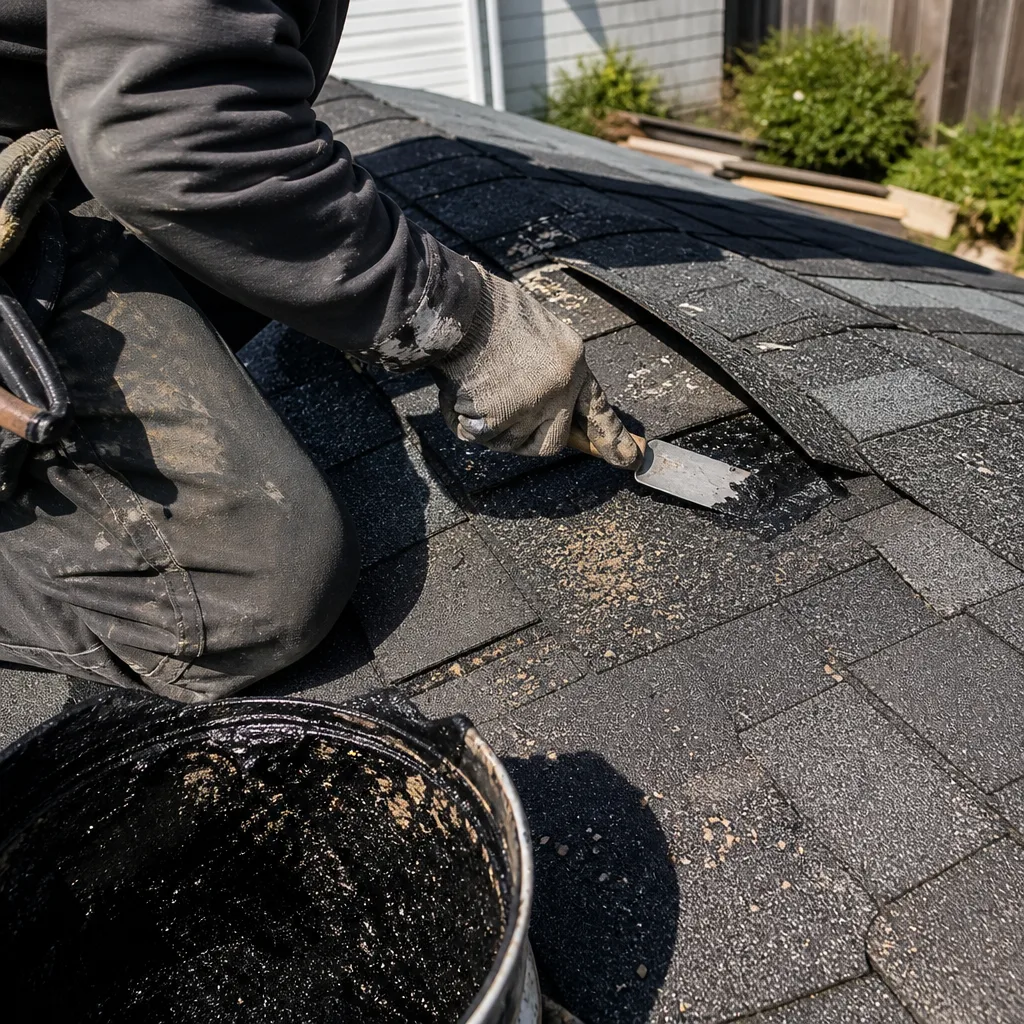
Blistering matters because it spreads. One small blister this spring is three larger blisters by fall, and by the following spring they’ve joined into a band of lifted membrane across the roof. Repairing a single blister is usually straightforward; replacing a roof where blisters have destabilized the entire membrane is not. If you see bubbling on your flat roof, call a Roof Repair in San Francisco specialist who works with modified bitumen and built-up roofs, not just shingles.
2. Ponding Water That Outlasts the Rain
Every flat roof holds some water during a storm. The question is whether it drains or evaporates within 48 hours of the rain stopping. Water that stands longer than two days is ponding, and ponding is a slow-motion demolition worker. It degrades the membrane, attracts debris that blocks drains further, adds weight stress to the deck, and in San Francisco’s damp climate it rarely dries fully on its own. We’ve seen ponding areas on Inner Richmond flat roofs that stay wet for weeks, feeding moss growth and membrane rot.
The problem is often a sagging deck or a low spot where the roof’s original slope has settled. Sometimes it’s a clogged drain or scupper. Sometimes the roof was built too flat to shed water properly in the first place, which is common on older San Francisco additions. If you notice a persistent wet patch on your roof three days after any rain, document it with a photo and note the date. Progression matters here: a pond that doubles in size over a season tells a different story than a pond that stays stable.
3. Seam Separation on Modified Bitumen
Many San Francisco flat roofs are covered in modified bitumen, which comes in rolls that are torched or adhered down with overlapping seams. Those seams are the roof’s seams, just like the seams on a jacket. Pull them and the whole garment fails. On a roof, seam separation shows up as a subtle line or lip where two membrane sheets have pulled apart by fractions of an inch. On a hot afternoon the bitumen softens and the seam can look sealed; on a cold or foggy morning you can sometimes see the gap.
Seam separation is a warning sign because it gives water a direct path to the substrate. The water then travels horizontally along the deck before finding a path downward, which is why seam failures often show up as interior staining far from the leak’s actual location. A separated seam is usually repairable with relative ease if caught early. Left alone, the membrane edges curl, collect debris, and widen. We recommend checking seams in fall, before the rainy season begins in earnest, when the dry surface makes small separations easiest to spot.
4. Drain Ring Rust Staining
Roof drains on San Francisco flat roofs sit inside metal or plastic collars that connect the drain body to the membrane. When the seal around that collar begins to fail, water seeps into the connection point, and the metal drain ring starts to rust from the inside. The warning sign is a reddish-brown or orange stain radiating outward from the drain on the roof’s surface, visible from the roof itself or sometimes from a window above.
Drain ring rust matters for a specific reason: the drain is the lowest point on any flat roof, and it’s where water spends the most time. A failing drain seal is not a slow warning sign. It’s an active leak that gets worse every time it rains. The good news is that drain collar repair is usually a contained job, provided the surrounding membrane hasn’t degraded. The bad news is that if the rust staining is extensive, the deck below the drain may already be damaged. Any rust staining around a drain should get a professional look within a few weeks of being noticed.
5. Parapet Cap Displacement
Flat and low-slope San Francisco roofs almost always have a parapet: a low wall around the roof’s perimeter. That wall is capped with metal, usually galvanized steel or aluminum, to keep water from getting into the wall itself. The cap is held in place by fasteners and sealant, and over years of fog, wind, and thermal movement, those fasteners work loose. The cap then lifts slightly, shifts sideways, or separates at the joints.
Parapet cap displacement is a warning sign because the cap is the roof’s first line of defense against water intrusion at the wall-roof transition, which is the single most common leak point on San Francisco homes. A shifted cap lets water run directly down into the wall cavity, where it can travel multiple stories before showing any interior evidence. We’ve traced top-floor ceiling stains in Bernal Heights homes to parapet caps that had been shifted for years while the membrane below remained intact. Checking your parapet caps is something you can do from the ground with binoculars on a clear day, and it’s a form of warning-sign reading that costs nothing but attention.
Interior Warning Signs Most San Francisco Homeowners Miss
Most people check ceilings for water stains and stop there. The problem is that water entering a San Francisco roof rarely travels straight down. It moves along joists, follows the slope of a deck, pools against a beam, and only then drips onto whatever surface happens to be below. By the time you see a stain on your ceiling, the water has often been inside the house for weeks or months. Two interior warning signs show up earlier if you know where to look, and neither appears on the ceiling surface itself.
Staining on Top-Floor Ceiling Joists, Not the Ceiling
In many San Francisco homes, especially Victorian and Edwardian construction, the attic or crawl space between the roof deck and the top-floor ceiling is partially accessible. That’s where the warning signs show up first: discolored or darkened wood on the top-floor ceiling joists, usually following the line where the deck meets the wall or where two joists meet. Water that enters through a roof seam or flashing failure often travels along the top of a joist before it ever reaches the finished ceiling below. The joist absorbs the water, darkens, and slowly rots, while the drywall beneath stays pristine.
Checking for joist staining means getting into your attic or crawl space with a flashlight and looking at the wood, not just the insulation. Focus on the areas directly under roof penetrations: plumbing vents, exhaust fans, skylights. If you see dark marks, water rings, or crumbling wood fiber, you have an active problem even if your ceilings look perfect. This is the single most valuable interior check we teach our San Francisco customers, because it finds leaks before they become visible damage.
Musty Smell in a Top-Floor Closet
Closets are the interior spaces most likely to show an early warning sign because they’re usually on exterior walls under low points of the roof, and they have limited airflow. Water that seeps into the wall cavity at a parapet or flashing point creates a persistent musty smell long before any visible staining appears. The smell comes from damp wood and insulation, and it’s most noticeable when the closet door has been closed for a few hours.
If you smell must in a top-floor closet, don’t reach for air freshener and move on. Note which wall the closet is on, then trace that wall upward to the roof: is there a parapet cap above it? A drain? A plumbing stack? The answer usually points to the leak’s entry point. Then call a Roofing Company in San Francisco that works on older homes, because the leak may be in the wall-roof transition rather than the roof deck itself. The smell will disappear when the water stops, not before.
How to Read Granule Loss: Normal Aging vs. Premature Failure
If your San Francisco home has a composition shingle roof rather than a flat membrane, granule loss is the warning sign you’ll hear the most about. The granules on asphalt shingles protect the asphalt from UV degradation. As a roof ages, granules naturally loosen and wash down into the gutters. Some granule loss is expected; too much means the shingles are failing early. The distinction matters because a prematurely failing shingle roof should be treated as an active problem, not a deferred maintenance item.
Normal Granule Loss
Normal granule loss is slow and relatively even. You’ll see a light dusting of granules in the gutters each fall, more after a heavy storm, less in dry years. The shingles themselves will show slight uniform lightening as the top layer of granules thins. On a roof that’s 15 to 20 years old, this is simply what aging looks like. The roof still has life in it, just less of it. No action is required beyond keeping gutters clear and monitoring.
Accelerated Granule Loss
Accelerated granule loss looks different. Instead of a light, even dusting, you’ll see heavy granule accumulation in downspouts and at gutter corners. The shingles themselves will show bare, dark patches where the asphalt is exposed, often concentrated on specific slopes rather than distributed evenly across the roof. In San Francisco, the fog-facing slopes and the slopes that get afternoon sun both lose granules faster than shaded slopes, which creates a visibly uneven pattern. If some slopes look bare while others look fully granulated, the roof is failing unevenly, and that’s a real warning sign.
The cause is often defective shingle manufacturing, improper ventilation trapping heat in the attic, or installation with the wrong fasteners. Whatever the cause, the remedy is usually replacement of the affected slopes, and sometimes the entire roof. Before you get multiple quotes, we recommend photographing the affected areas and noting which slopes show accelerated loss. That documentation helps any contractor give you an accurate assessment quickly. Birchbark Roofing works with Roof Replacement in San Francisco materials from GAF, CertainTeed, and Owens Corning, but the shingle brand matters less than the installation quality and the ventilation assessment.
The One Sign That Almost Always Means Flashing Failure, Not Membrane Failure
Here’s a scenario we see regularly across San Francisco. A homeowner notices a water stain on the top-floor ceiling, usually near an exterior wall or under a skylight. They call a few roofers for bids. Two of them say the roof needs full replacement, quoting $15,000 to $25,000. The third says the flashing has failed and the repair will cost a few hundred dollars. The homeowner goes with the full replacement quote out of caution, spending thousands on a roof that wasn’t the problem. This happens constantly, and it happens because one specific warning sign gets consistently misdiagnosed.
That sign is staining directly under roof penetrations: skylights, plumbing vents, chimneys, and exhaust fan housings. When the stain appears in a line or ring around the penetration itself, on the ceiling below, the problem is almost always the flashing around that penetration, not the roof membrane around it. Flashing is the metal or membrane material that seals the joint between the roof surface and whatever pokes through it. It fails long before the roof itself does, because it’s the point of highest thermal stress and the point where water naturally concentrates.
Why does this misdiagnosis happen so often? Because replacing a full roof is more profitable than repairing a flashing detail, and because many contractors default to the most comprehensive fix rather than investigating the specific leak. The homeowner, understandably, trusts the professional. But the math is simple: if the only interior staining is under penetrations, and the roof membrane itself shows no blistering, ponding, or seam separation, the membrane is probably fine. The flashing needs repair or replacement, and that’s a contained job. Getting a second opinion from a contractor who does not default to full replacement can save a San Francisco homeowner four figures. We recommend asking directly: “Is this a flashing failure or a membrane failure?” A good roofer will show you exactly why they believe one or the other.
The Photo-Documentation Method: Tracking Slow Warning Signs Over Time
Warning signs on a San Francisco roof move slowly. A blister grows by fractions of an inch per year. A ponding area expands by a few inches each rainy season. A seam separation widens imperceptibly. If you check your roof once and take no notes, you’ll have no way of knowing whether what you saw this year was worse than what you saw last year. Memory is not a reliable tool for tracking slow changes. Photos are.
Here’s a simple method we teach every homeowner who asks us to assess their roof. It takes fifteen minutes twice a year and gives you hard evidence to show any contractor you hire.
- Pick a schedule. Check your roof twice a year: once in early fall, before the rain starts, and once in late spring, after the rain stops. Set a calendar reminder. Consistency matters more than frequency.
- Photograph from the same positions. Stand in the same spots each time, at the corners of the roof perimeter or at the access ladder. Use the same camera or phone if possible. The photos need to match, not win awards.
- Capture the same fixed points. Photograph each roof drain, each penetration (skylights, vents, chimneys), each parapet cap joint, and each area where you’ve previously seen warning signs. Include a few wide shots for context.
- Include a reference object. For close-up shots of blisters, seam separations, or rust staining, place a coin or a ruler in the frame. This gives scale and lets you see growth over time.
- Date and store the photos. Put them in a folder named for the check date. Don’t rely on the camera’s auto-filing. A simple digital folder structure keeps years of photos organized and comparable.
- Compare before you call a contractor. When you suspect a problem, pull up the last two or three sets of photos and look for changes. That progression information is exactly what a good roofing contractor needs to make an accurate assessment.
This method costs nothing and takes almost no time once the schedule is set. It also protects you from misdiagnosis: if you can show a contractor two years of photos where a blister has stayed the same size, they’re less likely to recommend unnecessary work. If the photos show accelerating change, you know you need to act. In San Francisco’s housing market, where many roofs are accessed only by a roof hatch or a narrow ladder, having your own photo record is genuinely valuable documentation.
Common Mistakes to Avoid
- Ignoring a small interior stain because it’s “barely visible.” Water that makes it through a roof has been traveling through your structure for weeks or months already. The stain is the end of the story, not the beginning.
- Assuming a flat roof is fine because it’s “only a few years old.” Installation errors and San Francisco’s fog exposure can shorten a new flat roof’s life dramatically. Age alone tells you nothing; condition tells you everything.
- Painting over ceiling stains without investigating the cause. The stain will return, and the underlying water damage will keep growing while the paint hides it from view. Investigate the roof first, paint later.
- Walking on your flat roof to inspect it without knowing what you’re walking on. A compromised membrane can be fragile, and a roof deck with subsurface rot can fail under a person’s weight. View from the perimeter or call a professional for an on-roof assessment.
- Getting only one quote and accepting it because it’s the “full fix.” The flashing-versus-membrane misdiagnosis we described earlier is common enough that a second opinion is worth the effort. The most expensive recommendation is not always the most accurate one.
- Waiting for the rainy season to address a warning sign. In San Francisco, roofing contractors get flooded with calls the week after the first big storm. Addressing warning signs in summer or early fall means you’re not competing for limited scheduling windows.
When to Call a Professional
Some warning signs are fine to monitor, and some deserve a professional assessment immediately. Call a roofer if you see rust staining around a roof drain, active water intrusion anywhere inside the house, seam separation wider than a quarter inch, multiple blisters across the membrane, or interior joist staining that has not been evaluated. These are signs of active problems, not potential ones. Also call if your photo-documentation shows a warning sign expanding between checks; progression is the most useful data you can provide, and it often means the difference between a contained repair and a major one. Birchbark Roofing San Francisco home offers free estimates in San Francisco, with a written price before any work starts, and a live person answers the phone 24 hours a day. Call (831) 228-3330 to schedule an assessment.
Frequently Asked Questions
Most contained flat roof repairs in San Francisco, such as sealing a separated seam, patching a blister, or repairing a drain collar, typically run between $400 and $1,800 depending on the scope and the roof’s accessibility. Larger repairs involving parapet caps or multiple flashing points can run between $1,500 and $4,000. You’ll see your exact number in writing before any work starts, which protects you from change-order surprises. Call (831) 228-3330 for a free estimate specific to your roof.
It should not, if you’re working with a contractor who provides a written price before any work begins. At Birchbark Roofing, the written price is never optional and never negotiated away after the fact. What changes the price is discovering hidden damage, which is why an accurate roof assessment before the work starts matters so much. Call (831) 228-3330 to get your written estimate.
Most contained repairs, such as flashing replacement, seam sealing, or blister patching, take between half a day and one full day. Larger repairs involving multiple areas or parapet work may take two to three days. We coordinate door schedules and quiet hours with you so the work disrupts your home as little as possible, and we photograph the clean-up before our crew leaves. Call (831) 228-3330 for a timeline specific to your roof.
Yes, mostly. From the ground with binoculars you can check parapet caps, shingle condition on visible slopes, and the state of flashing around chimneys visible from the street. For flat roofs, a ladder at the roofline lets you see the membrane surface without walking on it. Walking on a flat roof you haven’t inspected before is risky, especially if there’s hidden deck damage. When in doubt, call a professional.
Sometimes, yes. Shingle manufacturers including GAF, CertainTeed, and Owens Corning have warranty programs that cover premature granule loss caused by manufacturing defects, though the warranty claim requires an inspection and documentation. Installation errors and ventilation problems are not covered by shingle warranties, which is why the installation quality matters more than the shingle brand. Bring your photos of the affected areas when you call for an assessment.
San Francisco requires permits for most roof replacements and for some larger repairs, and we handle the permit process as part of the job. We pull the permits, coordinate the inspections, and make sure the final inspection passes before we consider the job done. This is part of the written price you’ll see before work begins. Call (831) 228-3330 to discuss what your specific roof needs.
The Bottom Line
San Francisco roofs warn in specific ways, and the warnings are usually subtle. Blisters, ponding water, seam separation, drain ring rust, parapet cap shift, joist staining, and closet mustiness are the signals that matter on this city’s flat and low-slope roofs. Granule loss needs to be evaluated for pattern, not just presence. Flashing failures are regularly misdiagnosed as membrane failures, and a second opinion saves real money. Photo-documentation turns slow changes into hard evidence, and early fall is the best time to schedule an assessment before the crews book out. For additional guidance, explore our more guides & resources. The roof is not the most exciting part of a house, but in San Francisco it is the part that quietly determines whether the rest of the house survives the fog years intact.
If you’re seeing any of the signs in this guide, or if you simply want a professional assessment of your roof’s current condition, call Birchbark Roofing at (831) 228-3330 to schedule a free estimate. We’ll give you a written price before any work starts, and a live person will answer when you call.
Written by Erik Lindgren, Owner at Birchbark Roofing San Francisco, serving San Francisco since 2000.
See the difference
 Before
 After
After Before
 After
After Before
 After
After